By UK Heat Pump Guide · Last reviewed
Best Heat Pump Brands UK: Compare Models, Not Just Names
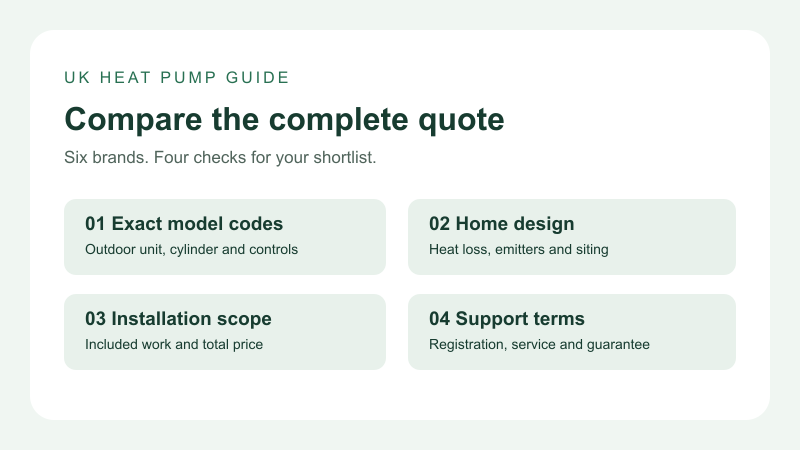
Mitsubishi Electric, Daikin, Vaillant, Worcester Bosch, Samsung and Nibe all have model families worth comparing for a UK heat pump quote. The useful shortlist is the one that fits your home, with a documented design, clear installation scope and support terms you can check. A brand name alone cannot establish which proposal will perform best in your property.
This is a comparison of manufacturer documentation checked on 11 September 2026, not a field test or a reliability league table. We compare six named ranges and explain what to request from an installer. We have not installed these six systems side by side, measured their performance or surveyed owners. The examples involving energy and prices below are fictional calculations, not market averages.
Start with your home's requirements before narrowing the list. Our home suitability guide introduces the practical questions, while the heat pump calculator offers a preliminary estimate. Neither replaces a property survey and room-by-room design. Keep your own priorities beside the quotations: available outdoor space, hot water needs, controls you can use, and access to local servicing.
Why the System Design Belongs in Your Comparison
An air source heat pump transfers heat from outdoor air into a water-based heating system. The proposed flow temperature, heat emitters and building heat loss therefore matter alongside the unit's capabilities. A useful comparison starts with the same design assumptions for every proposal, rather than comparing each manufacturer's most favourable brochure number.
Ask the designer for a room-by-room heat loss assessment and the outdoor design temperature used. These are design estimates, based on the building and assumptions in the calculation. Ask which radiators or underfloor heating zones can meet those requirements at the proposed flow temperature. If two quotations use different assumptions about insulation, room temperatures or radiator changes, resolve that difference before comparing the equipment.
A high advertised maximum water temperature does not show whether your existing radiators are suitable or what your annual electricity consumption will be. Lower flow temperatures can improve efficiency, but the design must still meet the rooms' heating needs. Request the proposed temperature and the evidence supporting it rather than choosing an arbitrary target for every home.
The Energy Saving Trust air source heat pump guide explains the relationship between emitters, lower operating temperatures and installation planning. Use it to prepare questions for a survey. The survey should turn general guidance into a written proposal for your property.
Understanding the Metrics: kW Capacity vs kWh Energy
To compare heat pump models effectively, you must understand the distinction between kilowatts (kW) of capacity and kilowatt-hours (kWh) of energy. Kilowatts represent instantaneous power. A heat pump's kW rating indicates a declared rate of heat output under specified test conditions. For example, a heat pump might be rated as a 5 kW or an 8 kW unit. This rating is a measure of capacity, not a constant rate of energy consumption.
Kilowatt-hours, on the other hand, represent the total quantity of energy consumed or delivered over a period of time. Your electricity bill is calculated based on the number of kWh of electricity your home consumes. The relationship between the heat energy delivered to your home (in kWh) and the electrical energy consumed by the heat pump (in kWh) is determined by the system's efficiency.
A 5 kW heat pump does not constantly draw 5 kW of electricity from the grid. If the heat pump is operating with an efficiency multiplier of three, it will consume approximately 1.67 kW of electrical power to deliver 5 kW of heat output. Many models can modulate their output over a range, but they also have a minimum output. Ask for that range at relevant operating conditions. Modulation does not guarantee an exact match to a home’s changing heat demand or eliminate cycling in every installation.
The Reality of Efficiency: COP, SCOP, and Seasonal Performance
When evaluating heat pump specifications, you will encounter three distinct metrics used to describe efficiency: Coefficient of Performance (COP), Seasonal Coefficient of Performance (SCOP), and actual system seasonal performance, often referred to as the Seasonal Performance Factor (SPF).
COP is a snapshot measurement of efficiency taken under specific, controlled laboratory conditions. For example, a manufacturer might state a COP of 4.5 at an outdoor air temperature of 7 degrees Celsius and a heating water flow temperature of 35 degrees Celsius (often written as A7/W35). This means that under those exact conditions, the unit delivers 4.5 units of heat energy for every single unit of electrical energy it consumes. While COP is useful for comparing units tested at the same conditions and measurement boundary, it does not represent how the unit will perform over an entire year in a variable climate.
To address this, the industry uses SCOP, which is a standardised seasonal calculation using prescribed conditions and a climate profile. While SCOP provides a more realistic basis for comparing different models, it is still a theoretical figure. A measured SPF describes performance over a stated period and measurement boundary. Check whether the reported figure includes hot water, circulation pumps or auxiliary heating before comparing two installations. This real-world efficiency is heavily influenced by factors that laboratory tests do not reproduce for your individual installation, including the quality of the installation, the accuracy of the hydraulic balancing, local weather patterns, and individual user habits.
A brochure SCOP is not a calculation of your personal electricity bill. To illustrate how these metrics translate into energy consumption, consider a fictional property with an annual space heating demand of 12,000 kWh. If the installed system achieves an actual seasonal performance factor of 3.0 over the year, the heat pump will consume 4,000 kWh of electricity to meet that heating demand (12,000 kWh divided by 3.0). This calculation is for space heating only, excludes domestic hot water generation and any backup heater usage, and does not predict a real bill or use a specific tariff. To understand how these energy calculations relate to running costs, you can read more about cost methodologies at heat pump running cost calculations.
Six Heat Pump Model Families to Compare
To help you navigate the market, we have compiled a practical, transparent shortlist of six current air source heat pump model families available in the United Kingdom. Rather than relying on subjective rankings, this comparison focuses on the specific documentation you should request and the precise questions you should ask your installer for each brand.
| Brand | Current Range | Document Check | Fit Question |
|---|---|---|---|
| Mitsubishi Electric | Ecodan R290 (PUZ-WZ) | FTC7 cylinder compatibility | Which phase, variant, and cylinder model are specified? |
| Daikin | Altherma 4 H W | Indoor wall-mounted package codes | Which indoor and outdoor codes form the quoted package? |
| Vaillant | aroTHERM plus | myREWARDS registration & cylinder eligibility | Which guarantee term and eligibility conditions are included? |
| Worcester Bosch | Compress 5800i AW | CS5800iAW indoor integrated solutions | What are the exact safety clearances for this R290 monobloc? |
| Samsung | EHS Mono R290 | AE050CXYDEK/EU (and 8/12/16 kW) codes | Is the optional SmartThings WiFi kit included in the price? |
| Nibe | S2125 | S-Series controls & myUplink documents | Which specific S2125 model size is proposed, and is it QuietMark certified? |
Detailed Model Analysis: What to Ask for Each Brand
Mitsubishi Electric Ecodan R290
The Ecodan R290 product page identifies the PUZ-WZ range and lists single-phase, three-phase and coastal variants. It also describes compatible FTC7 cylinders. Those distinctions matter when two proposals both say “Ecodan” but contain different packages.
Request the outdoor unit, cylinder and controller codes. Ask the installer to explain the chosen variant in relation to the electrical supply and location of your property. A coastal option should be considered against the manufacturer's stated conditions, not treated as a promise that corrosion cannot occur.
A useful question is: “Which outdoor variant, electrical phase and cylinder are included, and where can I find the matching installation documents?” Keep the answer with the quotation so that a later substitution can be checked against the original design.
Daikin Altherma 4 H W
The Daikin Altherma 4 H W page describes an indoor wall-mounted air-to-water package and connections to different types of heat emitter. A quotation should identify the matching indoor and outdoor units, rather than list “Daikin Altherma” without a generation or model.
An earlier generation is not automatically an unsuitable choice. Ask the installer to justify the specific package proposed using its documentation, availability and design performance. A newer product name alone is not evidence of lower running costs in your home.
Ask: “Which indoor and outdoor codes are included, and what output is available at our proposed flow temperature and outdoor design condition?” If the installer changes one component, request confirmation that the package and calculations remain appropriate.
Vaillant aroTHERM plus
The new aroTHERM plus page advertises a two-year standard guarantee and an extension up to seven years, with cylinder and installer registration conditions. It describes installation with a Vaillant cylinder and registration through myREWARDS; it also notes possible extra upgrade costs when an eligible cylinder is not included.
Treat “up to” as a condition to investigate, not a term automatically attached to every quotation. Ask for the guarantee duration, registration responsibility, relevant cylinder and any extension charge in writing. Check the terms applying to your purchase rather than assuming an earlier offer still applies.
Your comparison question is: “What guarantee will this exact package receive, what must happen to register it, and what ongoing conditions apply?” Keep the confirmation with the handover documents.
Worcester Bosch Compress 5800i AW
The Compress 5800i AW page describes an R290 monobloc with indoor integrated options. Ask for both parts of the package and a siting plan based on the model-specific installation instructions.
The manufacturer's table provides a useful acoustic example: the CS5800iAW 4 OR-S is listed at 40 dBA sound power and 32 dBA sound pressure at one metre. These are different quantities, not competing claims about the same reading. They do not predict the sound at a particular neighbouring window.
Ask: “Which model and indoor solution are quoted, and which acoustic data and clearance instructions have you used for this location?” The answer should identify the relevant documents and operating conditions, not simply describe the unit as quiet.
Samsung EHS Mono R290
The Samsung EHS Mono R290 page includes the 5 kW AE050CXYDEK/EU model and larger options. Its advertised 35 dBA figure has a footnote describing a three-metre, anechoic-chamber test under A7 conditions. That context prevents a direct comparison with another manufacturer's one-metre reading.
The page also identifies an optional WiFi kit for SmartThings connectivity. If remote control matters to you, ask whether the necessary kit, controller and setup are included. Check how you will operate the system locally as well as through an app.
Ask: “Which connectivity components are included, and which model-specific sound data support the siting assessment?” An app feature or an isolated noise figure should not replace the rest of the design comparison.
Nibe S2125
The Nibe S2125 page describes compatibility with S-Series indoor modules and myUplink controls. Its Quiet Mark footnote identifies the S2125-8 and S2125-12, with other models pending at the time of this check. Do not transfer a model-specific certification to every unit carrying the family name.
Ask for the exact size and the matching indoor module, plus the performance documents used in the design. If acoustic certification is part of the sales discussion, verify the status of the proposed model at the time you buy.
Ask: “Which S2125 model is specified, and what documentation supports its output and sound characteristics in this proposal?” A badge may be useful evidence for its stated scope, but it does not establish reliability or suitability for your property on its own.
Acoustic Metrics: Sound Power vs Sound Pressure Explained
Noise is one of the most common concerns for homeowners installing an air source heat pump, and it is also a frequent source of confusion due to the way acoustic metrics are reported. When comparing brands, you will encounter two distinct terms: sound power and sound pressure. Understanding the difference between these two metrics is essential to avoid making incorrect assumptions about how quiet a unit will be in practice.
Sound power describes the source's acoustic output under stated operating conditions. Sound pressure describes the level at a measurement position; distance, surroundings and test setup affect it. A declared sound power level is therefore different from a sound pressure reading taken several metres away. Operating mode and model size also belong in the comparison.
The Worcester Bosch and Samsung examples above illustrate the trap: one-metre and three-metre readings cannot establish which installation will be quieter. Nor can a single low-noise-mode figure establish performance at full heating demand. Ask for the measurement type, operating condition and model code beside every number.
Ask the installer to explain the acoustic assessment relevant to your location and proposed installation. The assessment position and applicable rules need to be established for the case; do not assume a reading at the property boundary alone settles compliance. Our heat pump noise and neighbours guide introduces the questions to raise. Keep the actual siting assessment with your quote, particularly where walls, windows or restricted outdoor space influence the design.
Refrigerant and Siting Documents
Several of the ranges in this comparison use R290. The useful purchasing question is which installation instructions apply to the exact model and where the installer proposes to put it. Do not copy a clearance distance from a different brand or assume that a smaller unit uses the same layout requirements.
Request a plan showing the unit, access for servicing and relevant surrounding features. Ask the installer to identify the manufacturer's clearance and safety requirements on that plan. If a proposed location changes after the survey, the installer should revisit the design rather than treat the move as a cosmetic change.
This comparison is not an installation procedure. Refrigerant, electrical and commissioning work require appropriate professional competence. Your role as a buyer is to obtain a documented proposal and understand the location being agreed, not to infer installation instructions from the refrigerant name.
Warranty Terms and Registration Requirements
Compare the written guarantee for the exact package. Record its duration, what is covered, who handles a claim and any registration or servicing conditions. Distinguish an advertised maximum extension from the guarantee actually included in your quotation.
The Vaillant example above shows why cylinder eligibility and registration can matter. It does not establish the rules for other manufacturers. Ask each installer to identify the relevant terms and any charge for an extension. Avoid assuming that every third-party cylinder prevents an extension or that every brand has the same basic term.
Check the required maintenance schedule and evidence you need to retain. Ask who can carry out servicing under those terms, what a service includes and how appointments are arranged locally. An annual service price and a repair call-out price are different entries in a budget. Our heat pump maintenance cost guide can help you frame those questions.
Finally, ask who you contact if the installer stops trading or no longer services that range. A written support route is more useful than an unsupported claim about which manufacturer has the biggest network. Keep installer workmanship cover separate from the manufacturer's product guarantee when comparing documents.
Comparing Quotes: A Fictional Financial Example
When comparing proposals from different installers, looking at the headline price alone can be highly misleading. To make a fair comparison, you must ensure that the scope of work, materials, and equipment included in each quote are completely equivalent.
Consider a fictional comparison between two proposals for a property, using illustrative figures on the same VAT basis, with no grants or incentives deducted:
- Quote A: The installer proposes an installation package for £11,000. However, the technical specification reveals that this price does not include the required compatible domestic hot water cylinder. A separate compatible cylinder must be added at a cost of £900, bringing the true equipment and installation cost to £11,900.
- Quote B: The installer proposes a different brand of heat pump for £11,700. This quote explicitly includes a pre-plumbed, fully compatible domestic hot water cylinder within the headline price, bringing the total cost to £11,700.
In this fictional scenario, Quote A appears cheaper at first glance, but it is actually £200 more expensive once the necessary cylinder is included. This example highlights why you must look beyond the initial unit price and examine the complete bill of materials. Check the remaining differences too: electrical work, radiator changes, controls, commissioning and disposal. Equivalent scope is the aim of the comparison; do not assume it merely because two totals are similar. For a comprehensive breakdown of the factors that influence the total cost of an installation, you can consult our detailed article on air source heat pump installation costs.
The Shortlist Decision Worksheet
To help you compare written proposals objectively, we have developed a practical shortlist decision worksheet. You should ask each installer to fill out these specific details for their proposed design before you make a final decision.
- Exact Model Codes: Request the precise product codes for both the outdoor unit and any indoor modules or cylinders. Do not accept generic brand names.
- Design Heat Loss and Flow Temperature: Ask for the calculated heat loss of your property (in kW) under peak winter conditions and the design flow temperature (in degrees Celsius) used to size the emitters.
- Emitter and Hot Water Upgrades: Ensure the quote details exactly which radiators need to be replaced and specifies the model and capacity of the hot water cylinder.
- Declared Performance Conditions: Request available output and efficiency data at conditions relevant to the design, identifying any estimates or interpolations.
- Siting and Clearance Plan: Ask for a physical plan showing where the outdoor unit will be placed and demonstrating compliance with all manufacturer safety clearances.
- Warranty Registration and Servicing Terms: Confirm the length of the warranty, the specific conditions required to secure any extensions, and the annual servicing requirements.
- Quote Inclusions and Total Cost: Verify that the total price includes all electrical work, structural mountings, commissioning, and handover documentation before any grants are applied.
Once your system is installed, you will need to receive a complete set of handover documents and controls instructions. You can prepare for this by reviewing our heat pump handover checklist checklist.
Next Steps: Your Three-Step Action Plan
Use these three steps to turn the comparison into a documented decision:
- Obtain Comparable Written Proposals: Reach out to professional installers and request detailed, written proposals based on a full room-by-room heat loss calculation. Ensure each proposal includes the completed details from our shortlist decision worksheet so you can compare them objectively. To find qualified installers in your area, you can search our directory at installer directory, keeping in mind that you must verify their credentials independently.
- Read the Handover Checklist: Familiarise yourself with the documentation, certificates and control instructions to agree as part of the handover upon completion of the installation. This will help you ensure your installer provides everything required to operate and maintain your system effectively.
- Check Certification Separately: Use the MCS product directory to check the specific product, and the MCS website to find the current installer-checking service. Product certification and installer certification are separate checks. A manufacturer having listed products does not establish the credentials of a particular installer or confirm every model in a range.
Keep a dated copy of the proposal and the product documents you used. If a model is substituted before installation, repeat the relevant checks rather than carry over the original comparison automatically. The decision is about the complete package you will receive, including the design and support arrangements.
Frequently asked questions
Which is the best heat pump brand in the UK?
There is no universal winner for every home. Compare specific models against the property design, installation scope and support terms. This guide compares manufacturer documentation for six ranges; it is not a field-tested reliability ranking.
Where can I find independent reliability evidence for heat pump brands?
Look for evidence that states the model, sample size, time period and method. This comparison has not established a statistically comparable reliability ranking for these six ranges. Manufacturer specifications and acoustic awards do not by themselves demonstrate long-term reliability.
Is Vaillant the only brand that offers R290 propane heat pumps?
No. Several major manufacturers, including Mitsubishi Electric, Worcester Bosch, and Samsung, offer current model families that utilize R290 propane refrigerant.
Does a high maximum water temperature capability guarantee my existing radiators are suitable?
No. A maximum temperature is a product capability, not a room-by-room radiator assessment. Ask the designer to check heat loss, emitter output and the proposed flow temperature. That design determines whether changes to existing radiators are needed.
What are the typical conditions required to extend a heat pump warranty?
Conditions vary by manufacturer and offer. Check the exact registration deadline, installer eligibility, package requirements, servicing terms and any extension charge in writing. Do not transfer the conditions for one brand to another.
Should I choose a quote based on the cheapest heat pump unit price?
Compare the complete installation scope and total price, including the required cylinder, electrical work, radiator changes and commissioning. A lower initial figure may omit work included in a competing proposal.
How do I compare sound levels between different heat pump brands?
Compare the same metric under comparable conditions for the specific models. Sound power and sound pressure are different quantities; pressure readings also depend on distance and surroundings. Ask the installer which data support the acoustic assessment for the proposed location.